You're currently on:
WHAT IS AN ACOUSTIC DELAY?
Physical Modeling is Only the Beginning
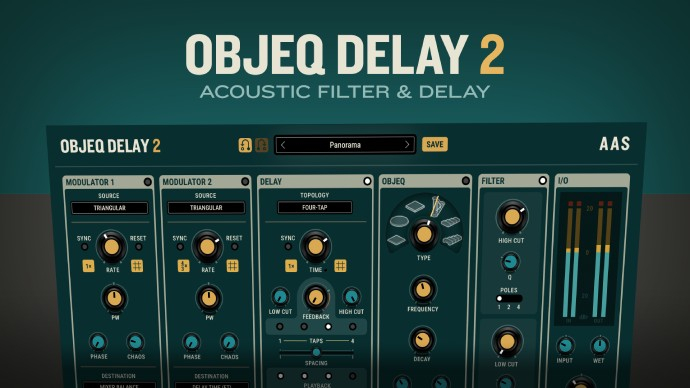
Objeq Delay 2 merges classic delay techniques with acoustic resonances in ways no other effect plug-in can match. Four delay topologies range from elegantly simple to intricately novel, with select modes featuring immersive psychoacoustic panning. Dual modulators provide LFOs, dynamics-based controls, and pitch tracking, enabling evolving and responsive effects. AAS's morphable acoustic filter weaves through it all, transforming these powerful tools into something entirely new.
------------------------------------------

What's New?
- Four delay topologies — one-tap, two-tap, four-tap, and split, each designed for a different kind of echo, rhythm, and spatial motion.
- One extra modulator — for complex, evolving effects.
- New Objeq module — features morphable object types and frequency‑response inversion for a wider range of resonant colors.
- Dedicated GUI for each engine — intuitive control and direct access to key parameters.
- Brand‑new user interface — fresh look with improved visual clarity.
- Brand-new library — 100+ inspiring presets for instant use, exploration, and discovery.

MAIN FEATURES
Echoes and beyond—moving, spatial, dynamic, acoustic
Discover the core features that make Objeq Delay 2 a true creative powerhouse.
Dual modulators - Twice the motion, take control
While LFOs are staples of effect movement, dynamic sources (envelope follower, RMS) and pitch tracking expand what's possible. Work with each modulator independently or combine them to create complex, performance-responsive effects.
Six modulation sources - Beyond the standard LFO
Rectangular, triangular, and sine shapes deliver familiar rhythmic motion, while RMS, envelope follower, and monophonic pitch tracking open the door to level, performance, and note-responsive effects. The result is modulation that feels both flexible and alive.
Four delay topologies - From classic to unexpected
One-tap, two-tap, four-tap, and split give Objeq Delay 2 a wide creative range, covering everything from simple echoes to animated multi-tap textures and staggered rhythmic patterns. Whether you want subtle support or bold transformation, each topology opens a different path.
Psychoacoustic panning - Natural spatial depth
Psychoacoustic processing uses arrival times and spectral cues to position sounds in the stereo field, resulting in a more subtle, immersive, and natural response.
Objeq filters - Blending acoustic color
Morph between plate, beam, drumhead, and string responses for a wide range of resonant colors. Flip the polarity switch to uncover alternate voicings and fresh tonal contours. More than a filter, Objeq becomes an expressive sound-shaping instrument in its own right.
Filter modules - Shape with precision
Dual low-cut and high‑cut filters with adjustable Q and 1, 2, or 4‑pole slopes let you move from subtle contouring to bold tonal sculpting. Tighten lows, smooth highs, and focus the resonance with precision, giving you clear control over weight, presence, and clarity